Quangong Machinery Co., Ltd.
News

What Are the Safety Features Every Concrete Block Mold Should Have?

2026-02-26 0 Leave me a message

In modern concrete block manufacturing, safety is no longer an optional design element. It is a structural requirement embedded into every stage of production, from mold engineering to installation and long-term operation. When evaluating a high-performance Mould for Concrete Block, the most critical question is not only about output capacity or block precision, but about how the mold protects equipment, operators, and overall production stability.


So, what are the safety features every concrete block mold should have? A reliable Mold for Concrete Block must incorporate high-strength wear-resistant materials, structural reinforcement to prevent deformation, vibration-resistant locking systems, precision alignment mechanisms, safe handling design, and long-life surface treatment to reduce operational risks. These features directly influence machine stability, operator safety, maintenance frequency, and total lifecycle cost.


At Quangong Machinery Co., Ltd., safety-driven engineering is embedded into every stage of our mold development process. Our factory integrates European technology standards with localized manufacturing precision, ensuring that every Mould for Concrete Block operates safely under high-pressure, high-frequency production environments.


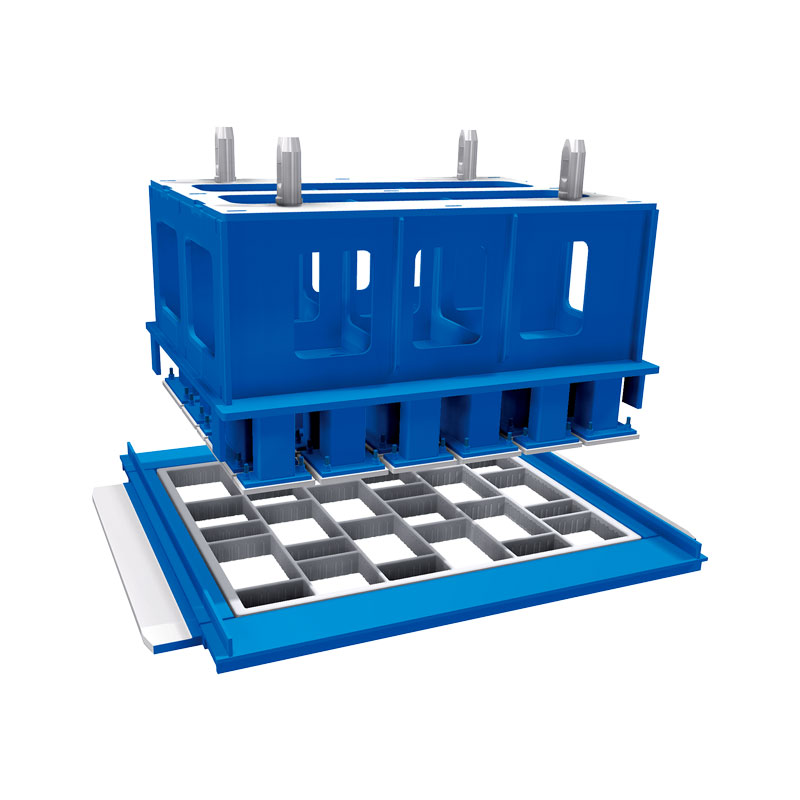
paver mould


Contents

1. What Structural Safety Standards Should a Concrete Block Mold Meet?
2. Why Do Material Selection and Heat Treatment Determine Mold Safety?
3. How Do Precision Engineering and Locking Systems Prevent Operational Hazards?
4. Conclusion
5. FAQ


What Structural Safety Standards Should a Concrete Block Mold Meet?

Structural integrity is the foundation of safety in any Mould for Concrete Block. During production, molds are subjected to extreme vibration, high compaction pressure, and repetitive impact cycles. If structural design fails, deformation or cracking can occur, potentially damaging block machines or creating hazardous conditions for operators. At Quangong Machinery Co., Ltd., structural safety begins at the design stage. Our engineering team performs stress analysis simulations to ensure that load distribution remains balanced under maximum vibration force.


Core Structural Safety Features

  • High-load bearing sidewalls reinforced with thickened structural plates
  • Optimized rib layout to distribute vibration force evenly
  • Anti-deformation internal framework design
  • Precision welded seams to eliminate structural weak points
  • Shock-resistant bottom plates for high-frequency compaction
  • Anti-crack corner reinforcement to prevent stress concentration


These structural elements ensure that the Mold for Concrete Block maintains dimensional stability over long production cycles. Stability directly reduces mechanical wear on the block machine and minimizes downtime.


Technical Parameters of Our Mold Structure

Material Thickness 12mm to 20mm high-strength steel plates
Structural Hardness 58 to 62 HRC after heat treatment
Vibration Resistance Designed for 4000 to 5000 cycles per hour
Maximum Compression Load Up to 120 tons depending on block size
Dimensional Tolerance Within 0.02mm machining accuracy


Our factory implements strict dimensional inspections before shipment. Every Mould for Concrete Block is tested for flatness, perpendicularity, and structural rigidity to eliminate risks before installation. Quangong Machinery Co., Ltd. continuously upgrades structural safety designs to align with global block production standards. By combining engineering precision with high-grade materials, we ensure that our molds operate safely under continuous heavy-duty workloads.


Why Do Material Selection and Heat Treatment Determine Mold Safety?

Material selection plays a decisive role in safety performance. Inferior steel can cause early wear, cracking, or sudden failure under vibration. A high-quality Mould for Concrete Block must use alloy steel specifically engineered for impact resistance and abrasion resistance. At Quangong Machinery Co., Ltd., our factory uses premium wear-resistant alloy steel sourced from certified suppliers. Each steel batch undergoes chemical composition verification to ensure consistency.


Critical Material Safety Characteristics

  • High carbon alloy steel for structural strength
  • Wear-resistant liner plates for longer service life
  • Impact-resistant core components
  • Anti-corrosion surface treatment
  • Tempered internal framework for fatigue resistance


Heat treatment is equally essential. Without proper quenching and tempering, steel components may become brittle or too soft. Our heat treatment process includes controlled atmosphere hardening and multi-stage tempering to balance hardness and toughness.


Heat Treatment Process Parameters

Hardening Temperature 850 to 900 degrees Celsius
Tempering Temperature 520 to 600 degrees Celsius
Surface Hardness Up to 62 HRC
Core Toughness High impact absorption capacity
Service Life Over 150,000 production cycles


By applying advanced heat treatment technology, our Mold for Concrete Block achieves longer wear resistance and reduced cracking risk. This significantly lowers replacement frequency and protects the block machine system. Quangong Machinery Co., Ltd. maintains full traceability for every mold component, ensuring consistent material performance across all production batches.


How Do Precision Engineering and Locking Systems Prevent Operational Hazards?

Precision alignment and secure locking systems are often overlooked safety elements. During high-frequency vibration, loose components can cause misalignment, uneven pressure distribution, and even mechanical failure. Our factory integrates CNC machining centers to achieve ultra-precise assembly tolerances. Each Mold for Concrete Block undergoes alignment testing to ensure seamless integration with block machines.


Operational Safety Features

  • High-precision CNC machining for tight tolerance assembly
  • Anti-loosening bolt systems
  • Reinforced clamping mechanisms
  • Secure locking pins resistant to vibration fatigue
  • Safe lifting holes for installation handling
  • Smooth surface finishing to prevent material buildup


Safe handling design is equally critical. Our molds include balanced lifting points and reinforced mounting positions to prevent accidents during installation or maintenance. Quangong Machinery Co., Ltd. ensures that each Mould for Concrete Block integrates seamlessly with automated block production lines, reducing manual intervention and improving operator safety. Through continuous R and D investment, we optimize vibration resistance and mechanical stability, delivering molds that combine performance with operational security.


Conclusion

Safety in a Mold for Concrete Block is determined by structural integrity, material strength, heat treatment precision, vibration resistance, and secure locking systems. A mold that lacks these features not only reduces block quality but also increases operational risks and maintenance costs.


At Quangong Machinery Co., Ltd., we integrate advanced engineering, certified materials, precision machining, and strict quality inspection to deliver safe and durable molds for global concrete block manufacturers. Our factory focuses on long-term performance, ensuring that every Mould for Concrete Block supports stable, efficient, and safe production. If you are looking to upgrade your block production line with reliable safety-driven molds, contact Zenith today to discuss your technical requirements and receive customized solutions that enhance both productivity and operational security.


FAQ

Q1: What Are the Safety Features Every Concrete Block Mold Should Have?

A high-quality mold must include reinforced structural design, wear-resistant alloy steel, precision heat treatment, vibration-resistant locking systems, anti-deformation framework, and safe lifting mechanisms. These features ensure long-term durability, machine protection, and operator safety under high-pressure production conditions.

Q2: What Are the Safety Features Every Concrete Block Mold Should Have to Prevent Deformation?

To prevent deformation, the mold should incorporate thickened steel sidewalls, optimized rib reinforcement, high hardness surface treatment, and balanced stress distribution design. Precision machining tolerance below 0.02mm also ensures dimensional stability during continuous vibration cycles.

Q3: What Are the Safety Features Every Concrete Block Mold Should Have for High-Frequency Production Lines?

For high-frequency production, the mold must withstand over 4000 cycles per hour. This requires hardened alloy steel, anti-loosening bolt systems, vibration-resistant locking pins, and impact-resistant structural plates to maintain alignment and prevent mechanical failure.

Q4: What Are the Safety Features Every Concrete Block Mold Should Have to Extend Service Life?

Extended service life depends on controlled heat treatment, surface hardness above 58 HRC, anti-wear liner plates, corrosion-resistant finishing, and proper stress relief processes. These reduce cracking and minimize replacement frequency.

Q5: What Are the Safety Features Every Concrete Block Mold Should Have to Protect Operators?

Operator safety requires secure locking systems, stable lifting holes for installation, smooth finished surfaces to prevent material blockage, and precision alignment to avoid sudden vibration shifts. These design elements reduce accident risks during installation and daily operation.

Related News
Leave me a message
X
We use cookies to offer you a better browsing experience, analyze site traffic and personalize content. By using this site, you agree to our use of cookies. Privacy Policy
Reject Accept